SMART-KS
System for Minimizing PUE (Power Usage Effectiveness) through the Application of Retrofit Technologies in Data Center Cooling Systems
Client: Federal Ministry for Economic Affairs and Energy (BMWE)
Project duration: April 1, 2025 - March 30, 2028
About SMART-KS
Initial Situation
The energy-efficient supply of technical systems, particularly in the field of cooling infrastructure, presents an increasing challenge. In today’s cooling systems, numerous energy conversion technologies often operate in a decentralized manner and with uncoordinated control logics. As a result, the various components are frequently not optimally aligned, which in practice leads to significant efficiency losses. In addition, infrastructure managers are often unaware of existing inefficiencies caused by incorrect or rigid setpoints or component sizing. The high complexity of these systems, constantly changing influencing factors such as outdoor temperature and cooling demand, as well as the absence of reference benchmarks, further complicate comprehensive analysis and targeted system benchmarking.
This project explicitly focuses on the supply systems of data centers. With currently more than 50,000 data centers, an annual electricity consumption of around 20 TWh, and roughly 7 million tonnes of CO₂ emissions, data centers already account for a substantial share of total electricity use and greenhouse gas emissions in Germany. In recent years, the construction of new data centers in Germany has been highly dynamic, which may further increase energy demand in the future. As a result, data centers play a crucial role in climate protection both nationally and across Europe. Improving energy efficiency therefore represents a key challenge for operators.
Although initial digital twins have been developed for specific subsystems of data centers and analyzed with regard to their savings potential, there is still no dedicated approach for the holistic assessment and optimization of retrofit measures across the entire cooling infrastructure using digital twin technology. This is precisely where the project comes in, addressing an important research gap with substantial practical relevance.
Objective
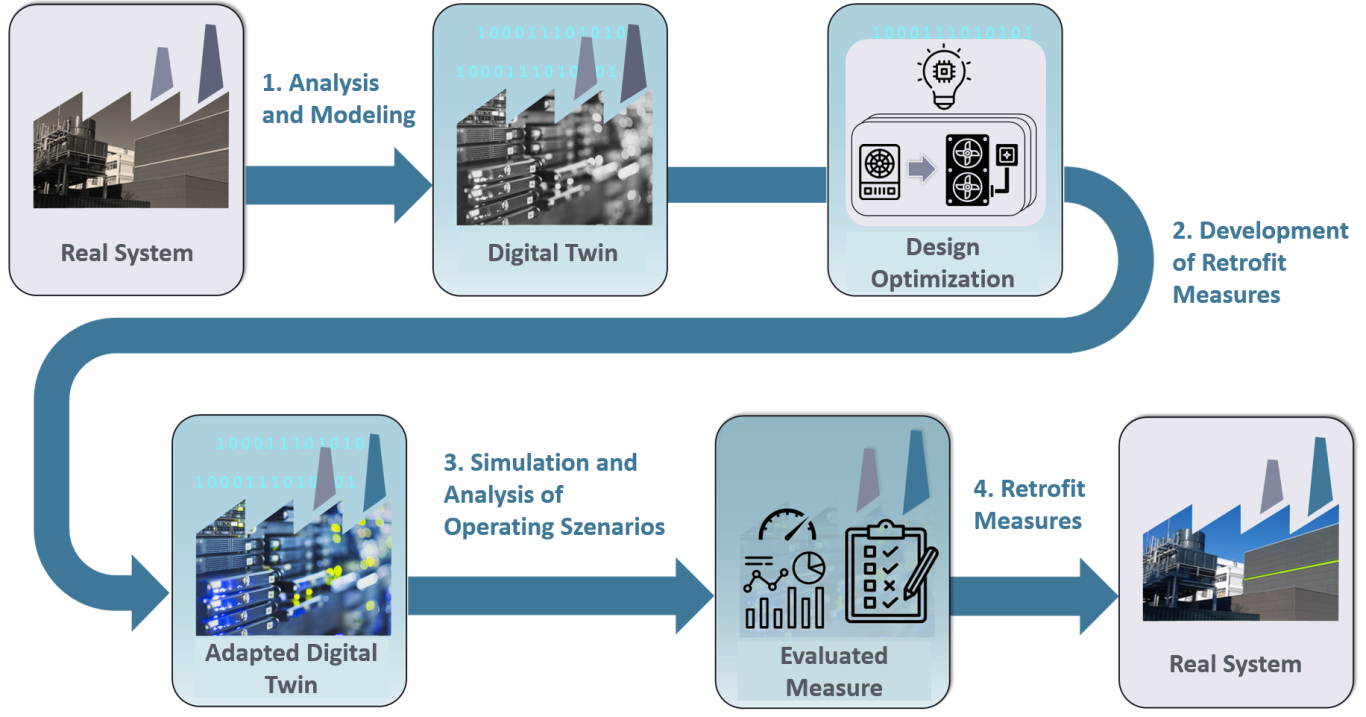
The primary objective of SMART-KS is to enable comprehensive analysis and energy optimization of cooling systems in data centers through the use of a digital twin. By using the developed digital twin, various retrofit measures can be simulated and evaluated in terms of their cost-effectiveness and potential to reduce emissions, based on energy cost savings. This provides the foundation for developing recommendations for the sustainable and efficient advancement of cooling systems.
Approach
SMART-KS is structured into five work packages (WP). Using the links provided below in the gallery, you can access detailed information about each work package. There, you will find further details about the project and its respective developments. The content is continuously updated. Please note that this information is currently available only in German. We apologize for any inconvenience this may cause.




Project Coordination

Project Partners